Mad Philosopher
  • Main Blog
  • Daily Resource Suggestion
  • About
  • Contact
  • Support This Site
  • A Philosopher's 95 Theses

Sax and Violence

1/9/2015

0 Comments

 
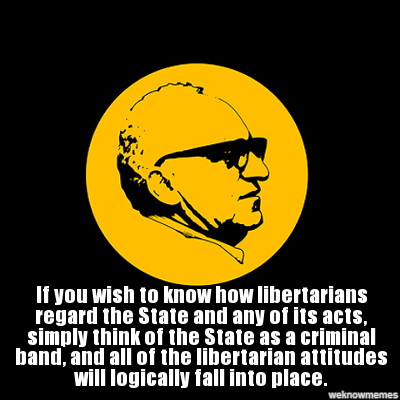
Everyone should know by now that I'm morally opposed to taxation in all its forms.  Many don't quite understand why that is the case, and those that do tend to disagree based on utilitarian reasoning.  If someone has seen my arguments on facebook, read this blog, or spoken to me in person for even fifteen minutes, and still do not understand my moral opposition to taxation, there is nothing I can do to help him.

The difficulty with utilitarian justifications (for anything, not just taxation) is that it compartmentalizes individual actions.  Why is it moral to abort Hitler but immoral to abort someone else's baby?  Why is it immoral to mug a guy in a back-alley (assuming you don't really, really need that money) but it is moral to take a percentage of their hard-earned wages against their will?

Utilitarian thought obfuscates moral and ethical considerations with a certain pragmatic results-oriented thought in which a perceived end can justify any action.  One useful tool to double-check utilitarian arguments for rectitude is to find the logical form of the argument being made and replace terms with functionally equivalent terms and see if the argument still matches one's intuition.

Sax and Violence is an excellent, artful, and cogent demonstration of this approach to double-checking a utilitarian argument.  There are those out there who will find that both taxes and saxes match their intuition... and those people terrify me.  There are those that will discover that both taxes and saxes are counter-intuitive after reading this article, as well.  However, it would take an act of willful ignorance to say that one is morally justified whilst the other is not.


You can watch a video that has a reading of the text and a further exploration of the idea, but the audio quality is a little shoddy.
0 Comments

Bastiat; a True Founding Father

19/8/2015

0 Comments

 
Today's resource suggestion is an excerpt from Economic Harmonies by Frederic Bastiat.
A 19th-Century philosopher and economist, Bastiat is credited with being one of the chief figures in classical liberalism which is, effectively, the progenitor of libertarianism and, ultimately, modern anarchism.
The excerpt is only 9 pages long, large-type, but it effectively expresses the basis of liberty and of the Anarcho-Capitalist position.  The first 8 paragraphs are filled with 19th century talk of God and creation and the created nature of man, but his more concrete observations made in and after these paragraphs can be confirmed and defended by atheists, too.
If reading isn't your forte or you desire a context for this work, I recommend reading Economic Harmonies or listening to/watching this lecture by Tom Woods.  It also provides a broader exploration of Bastiat's works, so it can be useful even after reading this excerpt.
0 Comments

Rothbard on De-Communization

10/7/2015

0 Comments

 
As promised, here's more Rothbard.  After a week of topical posts, I thought it would be appropriate to suggest a more timeless resource.  Few things are as timeless as Rothbard.  I was listening to an episode of Radical Agenda, and a caller reminded me of a short essay by Rothbard that lent itself heavily to my conversion from techno-marxism to anarchism.
It's a surprisingly difficult article to find and, somehow, the only places I've been able to find it is on leftist websites.  This is ironic, as it is essentially taking the legitimate tools of the lest and turhing them to the ends of liberty and justice.  The main thrust of the article is about a practical and principled solution to "public" property (ie. state property) in the hypothetical case of an orderly dissolution of government.
Everyone, even those who know Rothbard, ought to read this article, as it presents a solution very similar to my own when people ask about what would happen to existing state infrastructure and corporations that are in bed with the state in an anarchist world.

Confiscation and the Homestead Principle is a work that ought to be published right alongside For a New Liberty, maybe even as an appendix.  There is a certain dry irony to the essay, as it essentially takes the kernel of truth hidden in marxism and sets it in the greater framework of anarcho-capitalism, exactly where it belongs.  There is a veiled but undeniable call for what amounts to the proletariat to occupy and overthrow the state's management of their places of work, much as there is in Marx's works.  Unlike Marx, though, Rothbard points out that such a repossession is not one centered on vengeance, labor theory, or class warfare, but instead on the basic principles of property rights and calling out the state on its rhetoric concerning "public property".
Picture
0 Comments

A Reminder to Listen to and Read Cantwell

8/7/2015

0 Comments

 
As I've said before, Cantwell, with rare exception, tends to say exactly what I'm thinking in more or less the way I'm thinking it.  He has an incredibly rational, well-read, and solidly grounded approach and interpretation of facts.  I'm not saying this because I agree with him, I'm saying it because he's managed to make me critically assess my beliefs and has led to me changing my position on a handful of things.  He's got a grasp of economics and the human condition that rivals and even surpasses that of Andreas M Antonopoulos.

He doesn't always couch his arguments in the most dispassionate or compassionate manner, but that's not his rhetorical style.  What he does is effective, and that's why those unable to measure up to his standards of integrity and knowledgeability are apt to attempting to silence and exile him.  It is ironic that the anarchist, atheist, asshole, with a criminal record from New York City is, quite literally, the conscience of "the liberty movement".
He recently posted what has rapidly become his most popular piece of work by a tremendous margin.  It was a response to the SCotUS' ruling mandating religious support of gay marriage licenses.  Unlike many people who simply look at such issues as either, "Yay! Gays!" or "Boo! Gays!" Cantwell and I have an identical and less-conventional position on such issues: tell the state to mind it's own goddamned business.

As is the case with any other economic or human social issue, government involvement makes everything worse rather than better.  The state has absolutely no reason, moral or otherwise to concern itself with the voluntary interactions of human beings, nor they types of agreements (or contracts, for those who believe in contracts) that humans make between themselves.  The Church has no reason to try to make sinners the enemy of the state and use violence to try to force them to behave morally, as it will only increase opposition to the Church, and justly so.  When did Christ ever take a sword to the adulterer?  In the same way, the state cannot use violence to force the Church to acknowledge the state's claim to redefine an institution as old as the human race in order to garner political support.
Inserting itself into the voluntary interactions of humans: forcing cake shops to serve customers, punishing churches that will not abandon their sacramental duties, and creating any number of perverse economic incentives will not make discrimination go away, it will justify and magnify it.  Just as people are incentivized to kill endangered species that come to roost on private property, they are incentivized to make protected classes of humans go away when they come to roost.
0 Comments

The Vatican as an Anarchist State

1/7/2015

0 Comments

 
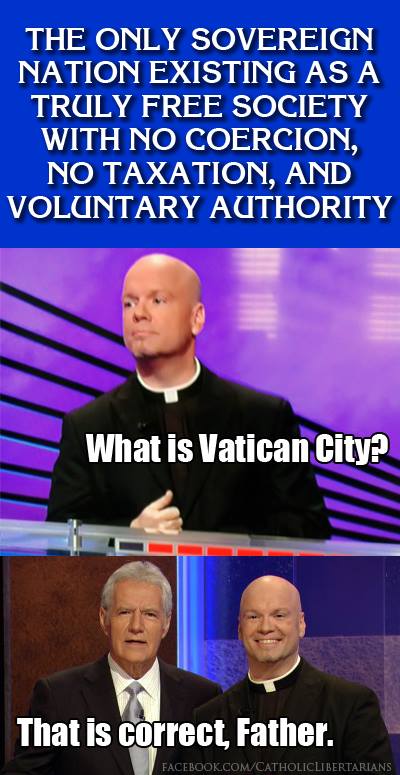
A question I still get asked a lot, if less frequently than before, is "How can one be a Catholic and an anarchist?"  Among the many opportunities one finds (mostly borne out of misconceptions about the Church) to raise doubts as to the compatibility betwixt the two is "Isn't the Church some sort of empire centered on the Vatican and using the mafia model to spread throughout the globe?"  I hope to write a full post about the intricacies of the relationship between freedom and faith in my philosophy, but this resource is a decent response to the specific question of "What about the Vatican"?

Today's daily resource post is an exploration of the relationship between religious and secular society, political theory as applies to "anarchist states".  It's a short, easy read (17 pages), and basically just explains away the misconceptions that lead to such a question.

You can read it on this page, or you can download it from Mises, here.

Oh, and one more thing, from whence do you think the mafia got it's organization structure?
Picture
0 Comments

Finally, Some Rothbard

29/6/2015

0 Comments

 
In a speech presented in 1994, Murray Rothbard explores "just war theory" in a very thorough and relevant manner, as is Rothbard's MO.  The transcript of the speech can be found here, and the audio of the speech is in the youtube video below:
Exploring the war crimes of various American and European leaders, the nature of the constitution and the articles of confederation exploring the cause for Somalia's current crises, pointing out the largely-ignored neo-puritan cult which swept up the Union and caused an unjust religious crusade against a neighboring nation, calling out our own government's (and all powerful governments') ongoing trend of abandoning just war theory in favor a total war doctrine which declares one's own citizens and civillians of neighboring nations as legitimate and desirable targets for the military. 

This speech is especially pertinent this week, after the social media and cultural debacle surrounding cultural revisionism and violations of people's rights at the hand of the government in the name of "equality".
0 Comments

Monopolies are the Boogeyman

29/5/2015

0 Comments

 
I have been slowly assembling a post about monopolies, as my more economically literate friends tend to fall on monopolies for their reason that anarchy cannot work.  This is not the case, for a great many reasons.  This article goes into a good explanation for some of them.
Picture
http://fff.org/explore-freedom/article/the-misplaced-fear-of-monopoly/
I know I share a lot of Tom Woods' material, but given that he is so prolific and so right, I can't help it.
0 Comments

54 Brief Arguments for Home Education

21/5/2015

0 Comments

 
I intend to address education more in the future, but fir now, I think this is a fun and handy guide for advocating home education over state education.  It's certainly not the most detailed or comprehensive argument, but it certainly provides a lot to think about and consider.
Picture
http://fivehundredyears.org/wp-content/uploads/2015/04/Comprehensive-case-for-home-education-v-1-0.pdf
0 Comments

Cantwell Reflects My Sentiments, Again

29/4/2015

0 Comments

 
http://christophercantwell.com/2015/04/28/an-open-letter-to-baltimore-rioters/
It's always encouraging when someone who I generally consider to be very intelligent and well-informed says the exact things that I have either previously said or have been thinking.  In this case, it's an honest and frank assessment of the situation in many major cities around the continent.
Not enough people who insist they are interested in freedom are willing to honestly and unabashedly address the issue of "what to do when faced with an adversary which possesses a monopoly on force".  Cantwell, in his rhetoric at least, sets an example for anyone who wishes to consider themselves freedom-minded.
0 Comments

Freedom of Opportunity

22/4/2015

0 Comments

 
The worst form of injustice is to attempt to make two unequal things equal.
~Aristotle
Today's resource is an essay that was published just last month by George Reisman.  Unfortunately, nobody has produced a free copy of it yet, but you can get the kindle version for 99¢ on Amazon.  It is a nice, short, easy read about why "equality of opportunity" is a dangerous lie.  If you agree, this will help bolster your arguments for what is a very true and very unpopular position.  If you disagree, I think you should read this essay and see what you think afterwards.

http://www.amazon.com/gp/product/B00VW8RJ26/ref=as_li_qf_sp_asin_il_tl?ie=UTF8&camp=1789&creative=9325&creativeASIN=B00VW8RJ26&linkCode=as2&tag=thomacom-20&linkId=JU4HXR3HDEQ4ZXSX
This article was recently featured in an interview with the author on the Tom Woods Show, in case you are too busy or poor to purchase and read the essay itself.  I strongly recommend that conservatives at least listen to this interview, as it may change your mind.  Not, towards the lefty "equality of results", but instead further away from that even more dangerous and gratuitous lie.
0 Comments
<<Previous
    Picture

    Archives

    October 2015
    September 2015
    August 2015
    July 2015
    June 2015
    May 2015
    April 2015

    Categories

    All
    Anarchy
    AnCap
    AnCom
    Audiobook
    Behind The Scenes
    Behind-The-Scenes
    Bitcoin
    Blog Post
    Book
    Charity
    Conspiracy
    Constitution
    CPS
    Cryptocurrency
    Cryptography
    D&D
    Dead Philosophers
    Documentary
    Drugs
    Economics
    Education
    Encyclical
    Epistemology
    Essay
    Ethics
    Family Life
    Fiction
    Health
    Infographic
    License
    Logic
    NAP
    Naturalism
    Non Aggression Principle
    NVC
    Phenomenology
    Podcast
    Police
    Polyamory
    Property
    Radio
    Religion
    Review
    Rhetoric
    Rothbard
    Science
    Skepticism
    Slavery
    Survival
    Technology
    Tool
    Trivium
    Utopia
    Video
    Video Game
    War
    Webcomic

    RSS Feed

Powered by Create your own unique website with customizable templates.